Routine support
Can you set useful reminders without treating a calendar date as a substitute for checking the plant?
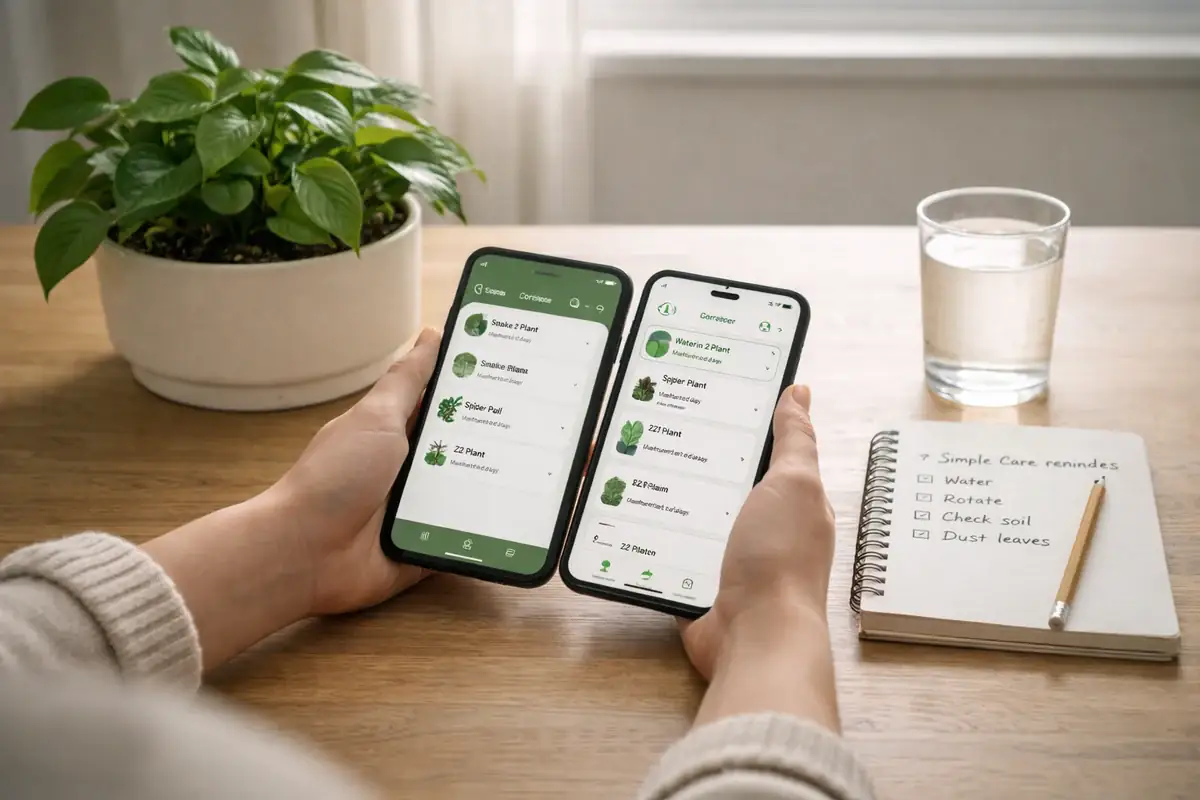
Plant Care Lab · Practical comparison
The best plant care app is the one that fits the way you actually look after plants. This guide compares common workflows—reminders, care records, identification, troubleshooting, and learning—so you can choose by fit instead of a headline winner.
How to choose
Can you set useful reminders without treating a calendar date as a substitute for checking the plant?
Does the app make it easy to record what you did and notice patterns over time?
If you do not know the plant, can the workflow move from a name to care guidance?
Does it help organize symptoms, likely causes, and the next observation to make?
Are explanations clear, and can you understand what data, plan, and device access are involved?
Side by side
There is no controlled benchmark behind these rows. Use them as a decision map, then verify current features, pricing, platform support, and privacy terms for your situation.
| App or approach | Consider it when | Trade-off to understand | Verify before choosing |
|---|---|---|---|
| Plantology | Consider it if you want identification, care routines, and plant-problem guidance in one Plantology workflow. | The all-in-one approach may be more than you need if you only want a simple watering reminder. | Check current platform support, plan terms, and whether its current plant and issue coverage matches your collection. |
| Planta | Consider it if your main job is building a repeatable care routine around reminders and a plant list. | A reminder-first workflow may leave you wanting a separate tool when identification or diagnosis is the harder problem. | Confirm which reminders, plant-care content, and features are included in the current plan and region. |
| PictureThis | Consider it if quick photo-based identification is the first step in your plant workflow. | An identification-led workflow may not be the same as a long-term care journal or a symptom-tracking system. | Check how the current product handles uncertainty, follow-up care, subscription prompts, and diagnosis-related guidance. |
| PlantIn | Consider it if you want structured care guidance and a plant list to support regular attention. | The right fit depends on whether its current guidance and tracking depth match the level of detail you prefer. | Review current supported features, pricing, export options, and the boundary between general guidance and diagnosis. |
| Seek by iNaturalist | Consider it if observation and learning about nature are more important than a dedicated household care planner. | Observation and community learning are different goals from reminders, watering history, or home-plant troubleshooting. | Decide whether you need a companion care system for recurring tasks and plant-specific records. |
Workflow notes
A reminder-led app can reduce decision fatigue when your main failure mode is forgetting a routine. Keep the reminder tied to a check of soil, light, season, and plant response rather than following a fixed date blindly.
A journal is useful when you want to see what changed after watering, repotting, moving a plant, or treating a pest. Look for low-friction notes and a history you will actually revisit.
Photo identification is most useful when it leads to a cautious next step. A plant name is a starting point; light, watering, substrate, and visible symptoms still need confirmation.
An all-in-one app can reduce context switching between identification, routines, and troubleshooting. The trade-off is a larger product surface, so check that the daily path feels simple enough to keep using.
A quick decision path
Questions people ask
Start with the job you need the app to solve most often: remembering routines, keeping a care history, identifying plants, or organizing a troubleshooting decision. A feature list matters less than whether that daily path is clear and sustainable.
No. Reminders are prompts, not proof that a plant needs water or fertilizer. Use them to look at the plant and its growing conditions, then adjust the action to what you observe.
No app should replace observation or professional advice for high-consequence decisions. Treat an app suggestion as a hypothesis, compare visible symptoms, change one variable at a time, and watch the response.
No. Plantology publishes this comparison and develops the Plantology app. The page states that relationship openly, avoids star ratings and invented benchmark data, and gives trade-offs readers can verify before choosing an app.
See the Plant Care Lab review methodology for the editorial scope, evidence boundaries, update policy, and the information this comparison intentionally does not claim.